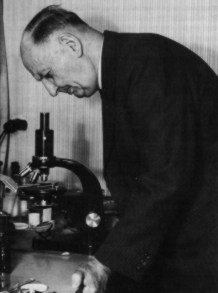
| He was born at Altefelde in West Prussia on 13th May, 1891. His original professional interest was chemistry, but as a junior-college teacher in Königsberg, East Prussia, he developed an advanced interest in the microfossils which can be etched out of Ordovician and Silurian rocks, occuring as Quaternary drift boulders from the Baltic area and commonly known as Geschiebe. He was not the first to observe or record chitinozoans, but he was the founder of the branch of palaeontology dealing with them, and he gave them a name and a scientific identity. In 1931 (with preliminaries in 1930), at the age of forty years, he isssued the first of a number of descriptions which revealed a new world of Palaeozoic organic-walled microfossils, including not only chitinozoans but hystrichospheres (sensu lato), melanosclerites (his own discovery), young astogenetic stages of graptolites, etc. As far as the chitinozoans are concerned, his pioneering was about 30 years ahead of international palaeontology. After this late start, he had half a century left for a career in palaeontology. In 1942 he was appointed docent at the University of Königsberg. |
| However, both his careers were interrupted for considerable periods as a prisoner of war. In world War 1 he was taken to Chita in eastern Siberia where he worked as a chemist. He used to praise this time as the most wonderful period of his life. When Königsberg was captured by the the Red Army on 9th April 1945, he was guarding a shelter with a medical unit. When found by the victors he was thrown on his back, his boots swiftly pulled off, his ura (watch) extracted, and he had to march off in his sokcs into the Soviet Union for protracted captivity. He did not talk much about that period. |
Soon after his return to Germany Alfred Eisenack was
appointed professor (in 1951, 60 years old) at the University of
TĂĽbingen and took up residence with his wife in nearby
Reutlingen. He vigorously resumed his research,
reconstructed what had been lost during the war by new
preparations and neotype designations. He travelled in the
source areas of his Palaeozoic Geschiebe, described new
material and widened particularly his dinoflagellate studies to
other areas and ages. He spent his memorable 70th birthday
in the field on Gotland. His international recognition was
reflected in an Honorary Membership of the Paleontological
Society. During the last two decades of his long life, still
pursuing his own, he was able to witness a new phase of
chitinozoan studies, boasted by scanning electron microscopy,
and the circles of chitinozoologists were widened considerably.
appointed professor (in 1951, 60 years old) at the University of
TĂĽbingen and took up residence with his wife in nearby
Reutlingen. He vigorously resumed his research,
reconstructed what had been lost during the war by new
preparations and neotype designations. He travelled in the
source areas of his Palaeozoic Geschiebe, described new
material and widened particularly his dinoflagellate studies to
other areas and ages. He spent his memorable 70th birthday
in the field on Gotland. His international recognition was
reflected in an Honorary Membership of the Paleontological
Society. During the last two decades of his long life, still
pursuing his own, he was able to witness a new phase of
chitinozoan studies, boasted by scanning electron microscopy,
and the circles of chitinozoologists were widened considerably.
| Alfred Eisenack (1891-1982) by A. Martinsson |




| GRAPTOLITE NET edited by Piotr Mierzejewski, the Count of Calmont and Countess Maja A. Korwin-Kossakowska 2002-2004 |